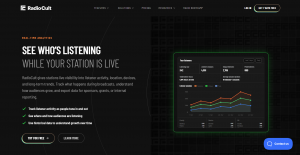
RadioCult's live and historical listener analytics provide detailed data on unique listeners, peak counts, session trends, and device as well as operating system breakdowns—information that stations can export to support sponsorship proposals and grant applications.
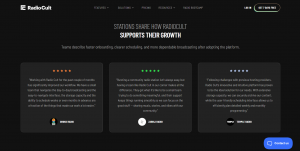
Independent and community stations like Oroko Radio, Zabrij Radio, and Temple Radio report that RadioCult offers quicker setup, more transparent scheduling, and improved broadcast reliability.
Roughly one-third of UK radio listening now takes place online. RadioCult evaluates what this transition means for independent and community broadcasters.
Listening moved onto connected devices, and that is the first time independent stations have been able to reach an audience on the same footing as a national network.”— A RadioCult spokespersonNEW YORK, NY, UNITED STATES, September 24, 2026 /EINPresswire.com/ — Radio consumption has not decreased—it has shifted. In both the United Kingdom and the United States, the proportion of radio accessed through internet connections has risen steadily year after year, putting independent and community broadcasters within reach of the same listener base enjoyed by national networks. RadioCult, an online radio platform tailored for independent broadcasters, has examined published industry data on where radio listening currently occurs and what this change means for stations operating without network-level budgets.
The first takeaway from the data is that radio remains a dominant mass medium. According to RAJAR's Q1 2026 figures, UK weekly radio reach stands at 50.6 million adults—87 percent of the population aged 15 and over—who collectively consume 1.007 billion hours per week, averaging 19.9 hours each. In the United States, Nielsen reports that radio reaches 92 percent of adults monthly and captures 61 percent of daily ad-supported audio time, outpacing podcasts at 21 percent and streaming music at 15 percent.
What has changed is the method of delivery. RAJAR indicates that online listening—encompassing smart speakers, websites, and apps—accounted for 30.4 percent of all UK radio hours in Q1 2026. Smart speakers alone represented 18.8 percent, up from 17.6 percent a year earlier, translating to roughly 190 million hours weekly. In the United States, Westwood One and Edison Research report that the streamed portion of AM and FM listening reached 13 percent, up from 7 percent in 2017, while Edison's Infinite Dial 2026 found that 81 percent of Americans aged 12 and older had listened to online audio in the past month. Close to a third of UK radio listening now bypasses traditional transmitters.
This structural shift is one that independent broadcasters should examine carefully. A station without a broadcast licence now reaches listeners through the same smart speakers, apps, and directories that host national stations, operating under the same conditions.
The independent segment of the industry is larger than often acknowledged. FCC station totals from December 2025 list 1,994 licensed low-power FM stations and 4,755 noncommercial educational FM stations across the United States. The UK government's Community Radio Order 2025 covers more than 300 analogue community radio services. Alongside these sit an uncounted number of online-only stations, DJ collectives, student stations, and religious broadcasters that hold no licence and do not appear in any of these tallies.
The audience they compete for is also migrating. Ofcom reports that UK listeners aged 15 to 34 now devote 58 percent of their audio time to streaming and podcasts, up from 40 percent in 2019. Nielsen puts radio's share among US 18-to-34-year-olds at 47 percent compared with 32 percent for podcasts, and Westwood One notes that the median podcast listener aged from 29 in 2017 to 39 in 2025. Younger audiences have not abandoned audio—they have distributed their listening across more formats, meaning a station present on only one platform encounters fewer of them.
"The headline that radio is dying has been wrong for a decade, but the headline that nothing has changed is wrong too," said a RadioCult spokesperson. "Listening moved onto connected devices, and that is the first time independent stations have been able to reach an audience on the same footing as a national network."
Taken together, the data points to three practical priorities for an independent station. The first is presence: the station must be listed and playable wherever listening now happens—across smart speakers, mobile apps, internet radio directories, and an embeddable player on its own site. The second is continuity: a station discovered through a directory at three in the morning needs something on air, which round-the-clock scheduling and automated playout can provide without requiring an engineer on staff. The third is measurement: a station that cannot demonstrate who listened, for how long, and from where has little to offer a sponsor or grant body.
Two additional considerations arise from the funding landscape. Independent stations rarely have the leeway to be penalised for a strong week, so unlimited concurrent listeners matters most when a show gains traction or a promotion hits. And because much of the sector relies on grants, donations, and sponsorship rather than advertising, exportable listener data often carries more value than a live dashboard alone.
RadioCult's guidance on growing an online radio audience and on monetizing your online radio station, alongside its analyses of UK and US listening data, are available on its website.
About RadioCult
RadioCult is an online radio hosting platform built for independent and community stations that broadcast 24/7 with multiple presenters. It combines live and automated broadcasting, radio-native scheduling, station and artist management, and unlimited concurrent listeners in one platform, with human support and pricing that starts at $33 per month. Learn more at https://www.radiocult.fm.
Corey Haines
Conversion Factory
email us here
Visit us on social media:
Instagram
Facebook
X