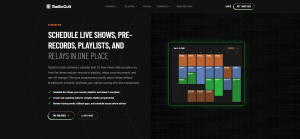
The RadioCult homepage, where broadcasters can start a 24/7 online radio station with scheduling, live and automated broadcasting, and unlimited concurrent listeners.
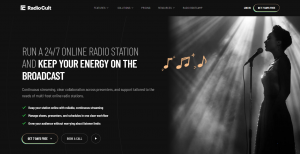
RadioCult's live player showing an on-air show, the upcoming schedule, and stream quality, alongside a five-star review from Oroko Radio.
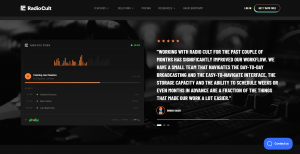
Custom repeating schedules, AutoDJ, fallbacks, and error checks: the features that matter most when comparing radio scheduling and automation software.
Scheduling is where stations get caught out. The software demos well, then real programming is full of rotations, exceptions, and one-off changes. That is the part worth testing first.”— A RadioCult spokespersonNEW YORK, NY, UNITED STATES, August 13, 2026 /EINPresswire.com/ — Evaluating radio scheduling and automation software is one of the more challenging tasks for a station, since most of the heavy lifting occurs after the initial demonstration. RadioCult, an online radio hosting platform designed for stations with multiple presenters, has outlined what to examine when comparing radio scheduling and automation solutions, leveraging its own scheduling capabilities and instructional resources.
Fundamentally, radio automation software manages playout and scheduling, ensuring that the correct content airs at the appropriate time and that a station continues broadcasting without manual intervention. The most advanced tools go beyond a simple playlist, integrating live shows, pre-recorded segments, playlists, stream relays, and AutoDJ within a single calendar interface.
The primary aspect to compare is how flexibly a system handles recurring programming. Real-world radio schedules rarely consist of straightforward weekly loops. Valuable options include daily, weekly, and monthly recurrence, complex patterns such as every third Thursday, multi-week rotations, and the ability to modify a single episode without disrupting the remainder of a series.
The second consideration is what occurs when issues arise. Reliable software offers fallback and loop options for when content runs short, overrun handling with configurable limits, and error checks that identify missing media or empty playlists before airtime, rather than during it.
"Scheduling is where a lot of stations get caught out," said a RadioCult spokesperson. "The software demos well, and then real programming turns out to be full of rotations, exceptions, and one-off changes. That is the part worth testing before committing."
The third factor is how well the tool accommodates a team. This includes calendar views by day, week, and month, drag-and-drop editing, event details such as linked artists and presenters, and filtering by tag or status. RadioCult's scheduling combines these features with live, pre-recorded, playlist, and relay scheduling, AutoDJ, per-event intros, and recording, all supporting unlimited concurrent listeners.
The ideal choice depends on the volume of programming a station runs and the number of people involved in the schedule, with multi-presenter and community stations typically requiring the greatest flexibility. RadioCult's scheduling feature and its guide to radio automation software are accessible on its website.
About RadioCult
RadioCult is an online radio hosting platform built for independent and community stations that broadcast 24/7 with multiple presenters. It combines live and automated broadcasting, radio-native scheduling, station and artist management, and unlimited concurrent listeners in one platform, with human support and pricing that starts at $33 per month. Learn more at https://www.radiocult.fm.
Corey Haines
Conversion Factory
email us here
Visit us on social media:
Instagram
Facebook
X