For any independent or community radio station with multiple presenters, the monthly hosting bill is rarely the number that matters most. The real question, as RadioCult sees it, is what that bill looks like after a year of adding shows, presenters, and listeners. RadioCult, a platform built for exactly this kind of growth, has laid out the key factors that drive online radio hosting costs over time — and what an affordable online radio hosting solution really means for stations planning beyond their first few months.
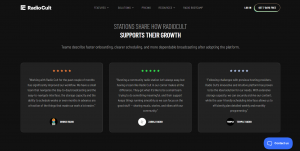
Stations including Oroko Radio, Zabrij Radio and Temple Radio already run their programming and archives on RadioCult, giving the company real-world insight into how costs evolve.
Listening, storage, team size and stream quality drive what a station pays as it grows. RadioCult outlines what to check before choosing a hosting plan.
Also worth a look: Audion and YouGov study reveals digital audio listeners now cross platforms freely and Derek Hui’s 400 weddings taught him the secret to decision-making isn’t love or money.
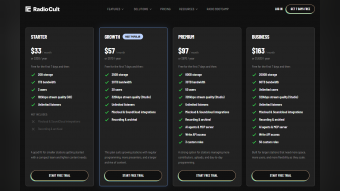
The better test of affordability is what the station will be paying a year from now, when there are more shows, more presenters, and more people listening.”— A RadioCult spokespersonNEW YORK, NY, UNITED STATES, November 5, 2026 /EINPresswire.com/ — Most stations compare monthly plan prices, but for a station with growth ambitions, that initial figure can be misleading. The more useful question is how the bill changes as the schedule fills, the presenter list expands, and the audience builds. RadioCult has outlined the four main cost drivers: listening, storage, team size, and stream quality. Which of these a provider charges on, and where the pricing tiers fall, determines whether growth leads to gradual increases or sudden jumps. RadioCult’s own plans run from $33 a month for Starter to $57 for Growth, $97 for Premium, and $163 for Business.
Listening is often the fastest-moving metric. Some hosting plans price by concurrent listener slots or listening hours — one listening hour equals one listener tuned in for one hour. Those hours accumulate quickly. A single listener tuned in 24/7 accounts for about 730 listening hours a month; a station averaging 50 listeners around the clock reaches about 36,500. Under a listener-based model, costs rise with the audience, so a popular show or a big live event can push a station into a higher tier just when it’s growing. RadioCult includes unlimited concurrent listeners on every plan, instead pricing its tiers on storage, bandwidth, and users.
Bandwidth is the technical cost behind listening, and stations can estimate it before choosing a plan. A 128 kbps stream uses roughly 57 MB per listener per hour, so those 36,500 listening hours come to about 2 TB in a month. RadioCult’s internet radio bandwidth calculator works this out from a station’s bitrate and average audience. RadioCult plans include a monthly bandwidth allowance of 5 TB on Starter, 20 TB on Growth, 30 TB on Premium, and 60 TB on Business. Bitrate is the main lever: higher bitrates sound marginally better but use bandwidth proportionally faster, and 96 to 128 kbps is usually enough for music.
For multi-presenter stations, storage is often the limit reached soonest. Pre-recorded shows are large files — a two-hour show at 320 kbps is close to 300 MB. A station with ten presenters each uploading one two-hour pre-record a week adds nearly 3 GB of audio a week, or more than 12 GB a month if nothing is cleared out. Storage is also the easiest measure to manage, since stations can remove older uploads or move finished shows to an archive. RadioCult plans include 5 GB, 25 GB, 80 GB, and 200 GB of storage, and from the Growth plan up they include recording and archival plus Mixcloud and SoundCloud integrations for publishing shows after they air.
Team size is priced in steps across much of the category, RadioCult included. Its plans cover 3 users on Starter, 20 on Growth, 50 on Premium, and unlimited users on Business. For a station adding presenters each season, the user count is often what decides the plan, and it is worth checking where the next step falls before the roster outgrows the current one.
Stream quality and features also change between tiers. RadioCult’s Starter plan streams at 192 kbps and the higher plans at 320 kbps. Some capabilities are sold as add-ons rather than included, so comparing add-ons is part of comparing price. On RadioCult, Connect, which lets a station handle scheduling and library tasks by asking an AI assistant such as Claude or ChatGPT, is included on Premium and Business and is a $29 monthly add-on on Starter and Growth. The 24/7 Music Recognition add-on is $49 a month on any plan.
Several options reduce the bill. Yearly billing on RadioCult is priced at ten monthly payments rather than twelve, so Starter costs $330 a year and Growth $570. Non-profit, student, and educational stations can take 20 percent off any plan billed yearly, on top of the two months already included. Every plan can be tried for seven days before billing begins.
Not every station needs to plan for growth. For a solo broadcaster streaming a few hours a week, an entry plan, or even a free tool, may be all that is required. The calculation changes for stations running regular programming with several presenters, where storage, users, and listening tend to grow together.
"Most stations pick a plan for where they are on day one," said a RadioCult spokesperson. "The better test of affordability is what the station will be paying a year from now, when there are more shows, more presenters, and more people listening."
A practical approach, according to RadioCult, is to estimate a station’s listening, storage, and team size twelve months out, check which of those each plan charges on, and price the plan the station will need then, rather than just the one it needs today. Full plan details are available on the RadioCult website.
About RadioCult
RadioCult is an online radio hosting platform built for independent and community stations that broadcast 24/7 with multiple presenters. It combines live and automated broadcasting, radio-native scheduling, station and artist management, and unlimited concurrent listeners in one platform, with human support and pricing that starts at $33 per month. Learn more at https://www.radiocult.fm.
Corey Haines
Conversion Factory
Visit us on social media:
Instagram
Facebook
X
Why it matters: As more independent and community radio stations grow their programming and audiences, understanding the real cost drivers behind hosting plans becomes essential. RadioCult’s breakdown shows that a plan chosen for today’s needs can quickly become a budget surprise, making forward-looking planning a critical part of any station’s sustainability.