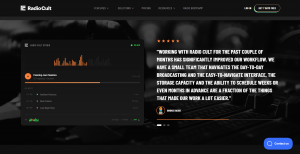
RadioCult's live player displaying an on-air program, the upcoming schedule, and stream quality, alongside a five-star rating from Oroko Radio.
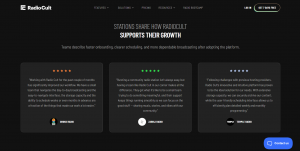
Independent and community broadcasters such as Oroko Radio, Zabrij Radio, and Temple Radio cite faster onboarding, clearer scheduling, and more reliable broadcasting when using RadioCult.
Keeping a Shoutcast or Icecast server operational takes real effort, and an increasing number of stations are shifting to hosting services that handle broadcasting, scheduling, and management for them.
Self-hosting gives stations real control, and many run it well for years. The stations that move to us are usually the ones who would rather spend their time on programming than on server upkeep.”— A RadioCult spokespersonNEW YORK, NY, UNITED STATES, August 6, 2026 /EINPresswire.com/ — A large number of internet radio stations launch with self-hosted streaming software and later consider moving to a hosted solution. RadioCult, an online radio hosting platform designed for stations with multiple presenters, has detailed the reasons behind such a transition and what it entails, referencing its guide to radio server hosting and its materials for stations leaving self-managed environments.
Self-hosting involves operating streaming software like Shoutcast or Icecast on a server that the station itself manages. This well-known method provides stations with full control over their configuration, and many stations operate it successfully over many years. However, it also means the station bears responsibility for hosting, installation, updates, bandwidth, and all technical issues that arise.
According to RadioCult, stations using self-hosted radio software typically begin considering a hosted platform when maintenance tasks start to interfere with programming. Frequent triggers include the time spent on server upkeep and applying updates, resolving internal server problems, adding presenters and managing access as the team expands, and operating scheduling, analytics, and listener tools as separate systems.
A hosted platform consolidates these functions. Broadcasting, scheduling, station management, analytics, chat, and mobile access all operate from a single interface, allowing the team to focus on programming rather than the underlying technology.
"Self-hosting gives stations real control, and many run it well for years," said a RadioCult spokesperson. "The stations that move to us are usually the ones who would rather spend their time on programming than on server upkeep."
RadioCult supports live shows, pre-recorded content, playlists, AutoDJ, and stream relays, along with scheduling, presenter and role management, embeddable players, an API, and listener analytics—all with unlimited concurrent listeners. For stations making the switch, it follows a four-phase process: relocating the stream, configuring the schedule and settings, running programming, and growing the audience.
This transition tends to suit independent and community stations with multiple presenters that want to reduce technical overhead. RadioCult's guide to radio server hosting and its resources on self-hosted radio software are available on its website.
About RadioCult
RadioCult is an online radio hosting platform built for independent and community stations that broadcast 24/7 with multiple presenters. It combines live and automated broadcasting, radio-native scheduling, station and artist management, and unlimited concurrent listeners in one platform, with human support and pricing that starts at $33 per month. Learn more at https://www.radiocult.fm.
Corey Haines
Conversion Factory
email us here
Visit us on social media:
Instagram
Facebook
X